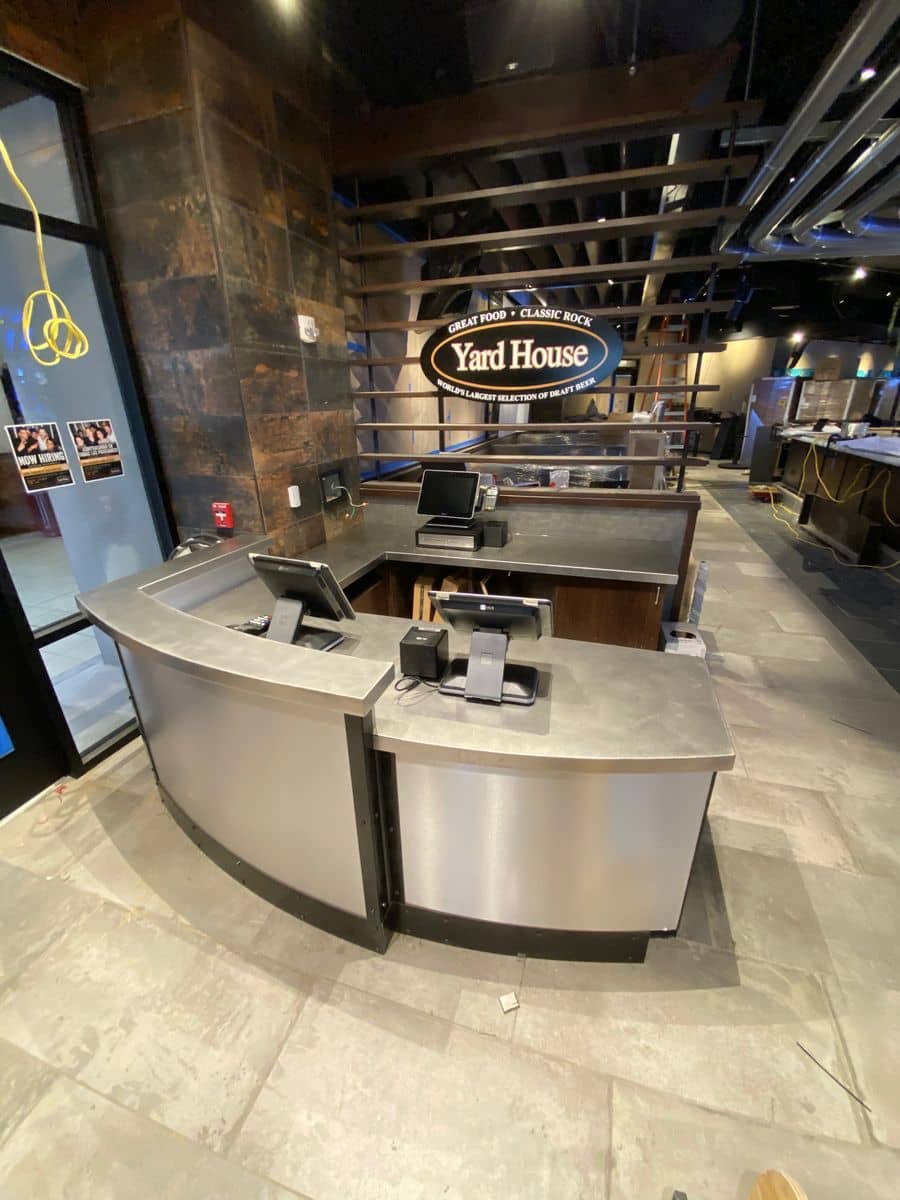
A custom stainless bar top is the longest-lived line item in most restaurant build-outs. It's also the most often spec'd by people who've never bought one before. The result is a bid sheet full of words that look like they mean something but don't, until you ask the right question.
This guide walks the decisions in the order they actually get made — from the room you're installing into through the documents that land in your binder on install day. The deep dives live in the individual cluster posts. The summary lives here.
Before you spec anything — three questions about the room
The stainless bar top isn't the first thing to decide. The room is.
- What's the service style? A craft cocktail bar with one bartender per six seats has different wear demands than a high-volume casual-dining bar pushing 500 covers a night. Service style determines gauge, edge, and finish.
- What's the lighting plan? Restaurant stainless is read under raking light. The lighting plan determines the right finish. A bar designed under shop fluorescents and finished for those fluorescents will look wrong under pendants.
- What's the lease horizon? A 10-year lease with renewal options changes the ROI math vs. a 5-year sublet with no renewal. The longer the horizon, the more day-one investment pays back.
The fabricator who starts with these three questions before they quote is the one whose price will hold up over the service life.
Material — 304 vs. 316, and what to demand on the mill report
Most restaurant stainless work is 304. 316 is required for coastal locations (chloride exposure from marine air), healthcare-adjacent applications, and any high-chloride-cleaning environment. 430 is not appropriate for customer-side or food-contact surfaces — it pits under chloride exposure and reads as rust within twelve months.
On every install, demand the mill test report under ASTM A240. The report names the heat number, the chemistry (Cr, Ni, C, Mo), and the mechanical properties. A fabricator who can't produce a mill report for the panels they delivered didn't buy what they said they bought.
Gauge — 14 vs. 16 vs. 18, by service style
Gauge is the counter-intuitive measurement where smaller numbers mean thicker steel.
- 14 ga (0.0747") — the customer-side standard for high-end bars. Heavy enough to produce the satisfying "thud" of a glass on the surface; rigid enough to never oil-can.
- 16 ga (0.0598") — the back-of-house and equipment-front workhorse. Adequate for surfaces customers don't see.
- 18 ga (0.0478") — budget gauge for ducting, splash panels, and non-touch surfaces. Never appropriate for a customer-side bar top — it dents under glassware and waves under hand pressure within months.
Spec the gauge by surface, not by project. A mixed-gauge spec on a single bar is the right answer most of the time. The full gauge breakdown covers the math.
Edge — the 3" bullnose default, and the five alternates
For about 70% of customer-side bars, the right edge is a 3" bullnose. The radius is comfortable against an elbow, the curve resists glassware chipping, and the form has decades of empirical performance behind it.
The five common alternates and when they fit:
- Marine edge — full water containment. Right for service-side surfaces near taps and sinks.
- Mitered edge — sharper architectural reveal. Right when the design language explicitly calls for it and the comfort tradeoff is acceptable.
- Drop edge / waterfall — the panel folds down over the front face. Right for design-forward bars where the side panel doubles as a visual element.
- Knife edge — extreme sharpness, fragile. Almost never appropriate for service surfaces.
- Half-round — decorative, common in older work. A holdover edge profile, rarely specified new.
The full field guide is in the edge profile post.
Finish — hairline, satin, mirror, M5 Oracle Sand
Finish selection determines what year five looks like.
- Hairline — parallel grain, dressy, unforgiving to scratches. Right for vertical decorative surfaces, wrong for bar tops.
- #4 satin — directional grain, hides moderate wear. The default for back-of-house. Acceptable for budget customer-side surfaces.
- #8 mirror — beautiful, brutal, shows everything. Right for accent panels only, never a service surface.
- M5 Oracle Sand — our documented two-orbital-sander figure-eight recipe on 2B mill 304. Non-directional grain that hides scratches by removing parallel reference lines. Designed for raking restaurant light.
ASTM A480 defines the standardized finishes #1 through #8. Anything outside that list — including M5 — is custom or architectural and only as good as the recipe behind it.
A finish is a description. A recipe is a specification. The difference is whether your bar top can be patched invisibly at year five. The M5 Oracle Sand post walks through the full mechanics.
Welding — TIG with argon back-purge
Welding is where most low-bid stainless work fails first.
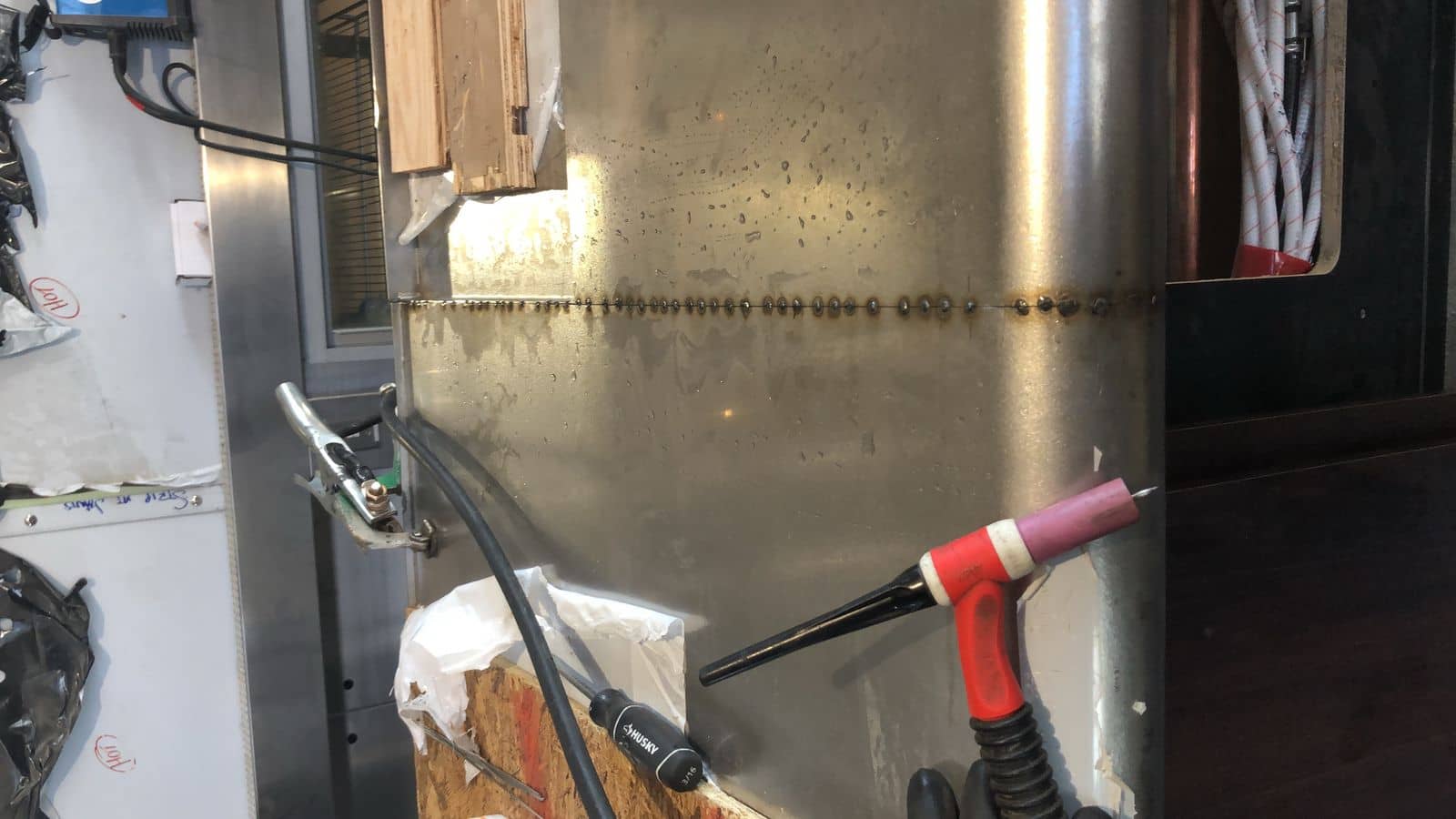
The standard for customer-side and food-contact stainless is TIG (gas tungsten arc) welding with an argon back-purge. The back-purge displaces oxygen from the back side of the weld during the heat-affected window, preventing the chromium-depleted oxide layer — visible as a rainbow heat tint — that causes rust streaking in service.
The shortcut substitutions are MIG without a back-purge (faster, cheaper, produces the rainbow tint), stick welding (acceptable in some industrial contexts, never in customer-side restaurant work), or no documented procedure at all.
AWS D18.1 is the standard for sanitary stainless welding. Specify it on the bid. The full walk-through is in the TIG welding post.
Passivation — the step that decides 20-year service
After fabrication, every weld and every cut edge has a disturbed passive layer — the chromium oxide layer that gives stainless its corrosion resistance is missing or thin in the heat-affected zone.
Passivation per ASTM A967 restores it. The modern standard is citric acid passivation (cleaner, safer, equivalent to nitric for most applications). The verification metric is the Cr:Fe ratio measured by a test cell — above 1.7 is the line for restaurant-quality work.
A bar top that wasn't passivated, or was passivated without documentation, is on a five-year clock from day one. The orange spots show up at the welds first, then the cut edges, then the panel surfaces if cleaning chemicals are aggressive.
This is the step low-bid shops most often skip because it adds a half-day to the production schedule and 3–5% to the cost. It's the cheapest 5% you'll spend on a 20-year bar top.
Install — site survey, templating, who shows up, who fixes a mistake
A custom stainless install is a sequence:
- Site survey — a 30-minute visit before fabrication to verify the room's actual dimensions, plumb, level, and penetration locations against the drawings.
- Templating — cardboard, laser, or hybrid template made on site to capture the exact geometry the fabricated panel has to match.
- Fabrication — cut, weld, finish, passivate, QC under raking light.
- Install day — substrate, dry-fit, weld in place, final polish, raking-light QC, walk-through, documents handed off.
- 30-day follow-up — confirmation call, any settling issues addressed under warranty.
The most important variable in install quality is whether the install crew is on the fabricator's payroll or is a local sub. In-house install teams produce fewer punch-list items, take responsibility for the full system, and protect the warranty. Subbed installs lower per-job cost and raise per-job risk.
The full install-day walkthrough is in its own post.
A 10-question spec checklist to put on every bid sheet
Run these on any custom stainless bid before you sign:
- Is the grade specified (304 / 316)?
- Is the gauge specified per surface?
- Is the finish specified by recipe name (not by description like "swirl")?
- Is the edge profile specified with dimensions and return geometry?
- Is the weld method specified as TIG with argon back-purge, citing AWS D18.1?
- Is passivation specified per ASTM A967, with target Cr:Fe ratio?
- Is the install crew on the fabricator's payroll, in writing?
- Is the lead time phase-by-phase, not just a single total?
- Does the warranty document cover both fabrication and install?
- Are the five hand-off documents (mill report, finish recipe, passivation record, as-installed photos, cleaning protocol) listed as deliverables?
A bid that satisfies all ten is a real custom stainless bid. A bid that misses any three is a price quote, not a project.
Bottom line — "built to last" is a documented process, not a slogan
A custom stainless bar top can last 20+ years in continuous restaurant service. It can also last 5. The difference is not the steel — it's the documentation. Finish recipe, weld procedure, passivation record, install log, and repair spec. The five boring documents that decide whether year 20 looks like year one.
The slogan over our shop door is "Built with precision. Built to last. Built by Low's." Each of those three sentences is a procedure, not a marketing claim. Built with precision is the templating discipline. Built to last is the documentation. Built by Low's is the install team that flies to your zip code instead of subbing it out.
If you're spec'ing your first custom stainless bar top and want a draft spec sheet you can take to any fabricator — including ones that aren't us — send us the floor plan. We'll redline it free. The shop you hire after that is your call.
The oldest bar top still bolted down under our name was installed before half our shop was hired. The customer has never been closed for repair on it. The finish recipe document for it is filed under the same coffee-stained tab it was filed under in 2003.
Everything on this blog comes off our shop floor and our job sites — 33 years of commercial stainless for In-N-Out, Yard House, SoFi Stadium, and 2,000+ builds across 35 states. If you're planning a project, we'll give you a straight answer on what it takes.